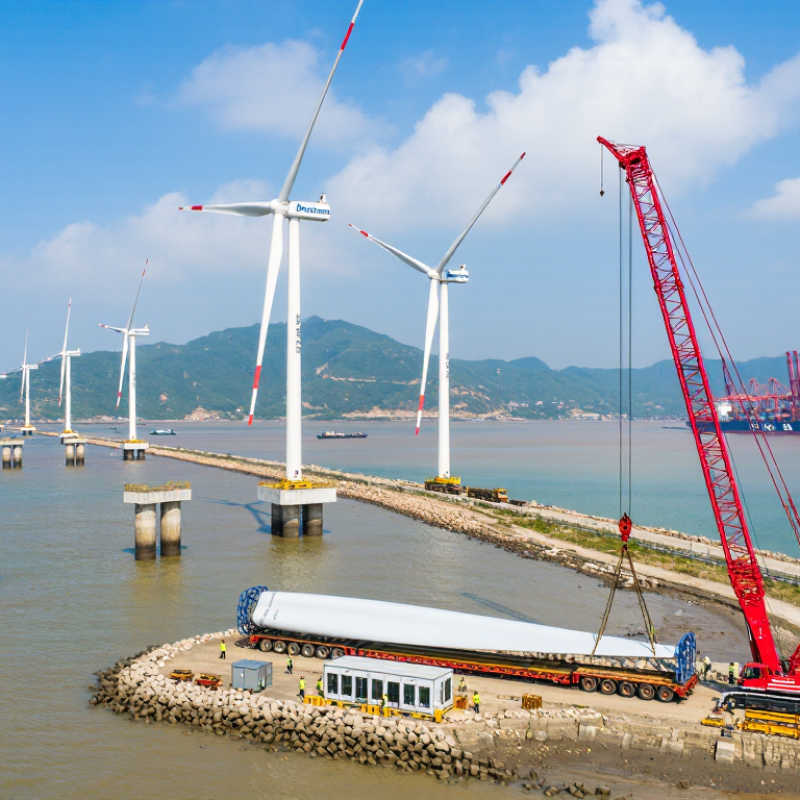
Choosing the best China wind energy project supplier requires more than comparing turbine prices. Developers must examine engineering capability, manufacturing consistency, delivery records, and long-term service support. A reliable supplier should explain its turbine platform, rated output, operating range, and expected performance in clear technical language.
Site conditions matter greatly. A coastal project may require corrosion-resistant coatings, reinforced towers, and careful port logistics. Mountain installations may demand modular transport plans, crane access studies, and flexible foundation designs. Experienced suppliers can provide wind-resource assessments, production estimates, grid-connection support, and detailed construction schedules. Their teams should also explain how they manage blade inspections, gearbox maintenance, spare parts, and remote monitoring after commissioning.
Independent verification remains essential. Buyers should review audited certifications, reference projects, warranty terms, factory quality procedures, and customer feedback from comparable climates. An established EPC partner may reduce coordination risks, but its responsibilities must be written clearly. No supplier is best for every project. Fit matters more. Some public performance data may be incomplete, and marketing claims can sound stronger than field results. That is why site visits, technical due diligence, and contract reviews deserve serious attention. A practical shortlist should balance lifecycle cost, bankability, safety culture, communication quality, and local support. The lowest quotation can become expensive when delayed components, unclear exclusions, or weak maintenance planning affect annual energy production. A careful comparison helps developers identify suppliers that are capable, transparent, and suitable for the project’s actual conditions.
China’s wind energy industry has developed a broad project supply chain, from steel processing to grid connection. Domestic factories produce towers, blades, nacelles, generators, and electrical systems at large scale. Many projects also depend on specialized bearings, control software, subsea cables, and heavy transport equipment. The chain is efficient, but not effortless.
Project suppliers must coordinate factory schedules with port capacity, road permits, vessel access, and seasonal weather. A blade leaving a coastal plant may travel through narrow village roads before reaching an inland site. Mountain projects create different problems. Steep slopes, weak bridges, and winter ice can delay installation. Experienced contractors inspect transport routes before equipment enters production.
Reliable procurement requires more than comparing prices. Buyers should review material certificates, welding records, factory acceptance tests, and spare-part plans. Serial-number tracking can connect a finished component to its inspection history. Independent quality checks are useful when several subcontractors share one package. Small documentation gaps can become expensive during commissioning.
China’s supply chain also benefits from dense manufacturing clusters and skilled engineering teams. However, capacity does not guarantee consistent performance. A rushed schedule may hide weak interface management between civil, electrical, and turbine contractors. Forecasts can be wrong, too. Some projects overestimate local logistics or underestimate grid-connection work. Better suppliers communicate early, report limitations clearly, and adjust plans when field conditions challenge the original design.
Selecting the best wind energy project supplier in China requires more than comparing turbine prices. The supplier’s operating record matters. The Global Wind Energy Council reported that global wind capacity exceeded 1,020 GW by the end of 2023, after 117 GW of new installations. Ask suppliers to provide verified project references, availability data, warranty terms, and evidence of long-term service performance. A polished presentation is not enough.
Technical capability should match the project site. Review wind-class calculations, extreme weather assumptions, wake-loss modeling, and foundation design. The International Energy Agency notes that grid integration and permitting increasingly influence renewable project schedules. Therefore, suppliers should explain grid-code compliance, power-quality testing, spare-parts planning, and remote monitoring. For offshore projects, inspect corrosion protection, installation vessels, subsea interfaces, and emergency procedures. Small gaps become expensive offshore.
Financial and operational reliability deserve equal attention. IRENA reported global wind power capacity at roughly 1,017 GW in 2023, showing the sector’s scale but not guaranteeing every supplier’s resilience. Examine audited financial information, manufacturing capacity, quality-control records, and cybersecurity practices. Request realistic delivery schedules, not optimistic promises. A factory tour can reveal storage conditions, inspection discipline, and whether critical components are actually available. Some evaluations still overvalue low capital cost. That is a weakness worth admitting. A stronger scorecard measures lifetime energy yield, downtime, service response, safety performance, carbon reporting, and end-of-life responsibilities. No scorecard is perfect. Regular independent reviews are still necessary.
The chart presents a practical procurement-weighting model for evaluating wind energy project suppliers. Project execution capability, turbine reliability, lifecycle service, grid integration, commercial transparency, and health and safety performance are commonly assessed before supplier selection.
The percentages represent recommended evaluation weights for a balanced supplier assessment and are not company-specific performance claims.
China’s leading wind turbine and project solution providers are judged by more than turbine size. They must manage feasibility studies, resource assessment, grid connection, construction, and long-term service. The Global Wind Energy Council reported that China added about 75.9 gigawatts of wind capacity in 2023. That represented roughly 65% of global new installations.
Strong suppliers usually provide complete engineering support. Their teams inspect terrain, compare wind measurements, and design transport plans for oversized blades. On a remote site, a delayed crane can cost several days of generation.
Reliable providers therefore combine digital monitoring with local maintenance crews. They also support foundation design, electrical integration, commissioning, and spare-parts planning. These details often matter more than brochure efficiency.
The International Renewable Energy Agency recorded China’s total wind capacity at more than 440 gigawatts by the end of 2023. This scale shows deep manufacturing experience, but scale alone does not prove project quality. Buyers should examine certified performance data, availability guarantees, noise controls, and cybersecurity procedures. Independent testing and transparent warranty terms deserve close attention. A supplier may offer a lower initial price, yet weaker after-sales support can increase lifecycle costs. The uncomfortable part is that public project data remains uneven across regions. Some comparisons still rely on supplier disclosures. Site visits, audited records, and references from operating projects are safer evidence. Wind development is technical, but it is never perfectly predictable.
Supplier capabilities differ sharply between onshore and offshore wind projects. Onshore suppliers often provide turbines, towers, foundations, roads, substations, and maintenance services. Their strength is usually fast delivery across difficult inland terrain. Experienced teams can adjust foundation designs after reviewing soil reports and transport limits. They also understand crane access, seasonal weather, and local grid conditions.
Offshore projects demand broader technical depth. Suppliers must coordinate turbines, subsea cables, monopiles, floating structures, ports, and installation vessels. Salt spray requires stronger corrosion protection. Typhoon zones require careful structural and control-system reviews. Reliable suppliers should show verified testing records, safety procedures, and previous offshore performance. They should also explain how spare parts reach vessels during narrow weather windows.
A serious evaluation should compare engineering capacity, factory quality control, welding records, delivery history, and after-sales response. Site visits can reveal more than polished presentations. Ask how suppliers handled a delayed shipment, a damaged blade, or unstable grid frequency. Their answers may expose practical experience. However, no supplier is perfect. Offshore schedules remain vulnerable to weather, vessels, and permits. Low prices can hide weaker inspections or limited service teams. Buyers should therefore review contracts, warranty terms, interface responsibilities, and long-term maintenance resources before selecting a project partner.
Selecting China-based wind energy project suppliers requires more than comparing quoted turbine prices. A credible procurement plan starts with precise technical specifications, delivery milestones, and measurable acceptance criteria. Request audited production records, material certificates, software versions, and spare-parts commitments before signing. Factory visits should examine welding areas, torque tools, coating thickness, and traceability labels. Small details matter.
Quality control works best through staged inspections, not one visit before shipment. Independent inspectors can witness incoming-material checks, assembly tests, electrical testing, and container loading. Require calibrated instruments and signed reports with photographs tied to serial numbers. For blades, review balance data, laminate repairs, lightning protection, and transport cradles. For towers, verify weld procedures, dimensional tolerances, paint systems, and bolt tension. A missed document can delay commissioning.
Regulatory review should match destination-country rules and project conditions. Map technical requirements against relevant IEC standards and local grid codes. Confirm product certifications, environmental approvals, customs documents, and worker-safety records. Contracts should define nonconformance handling, warranty response times, data ownership, and dispute procedures. Do not rely on certificates emailed as scans. Verify issuing bodies and validity independently. One uncomfortable lesson remains: the lowest bid may hide inspection, logistics, or compliance costs. Even strong audits have blind spots, especially when subcontractors change mid-project. Keep an updated supplier risk register.
| Evaluation Dimension | Supplier or Project Category | Key Data and Recommended Benchmark | Verification Documents or Tests | Procurement and Compliance Implication |
|---|---|---|---|---|
| Procurement and Commercial Assessment | ||||
| Supply Scope | Complete wind turbine package | Confirm whether the quotation includes the turbine, tower, control system, transformer, transport, erection, commissioning, training, and spare parts. | Detailed bill of materials, interface matrix, supply-boundary schedule, and exclusions list. | Use a single responsibility matrix to prevent gaps between the turbine supplier, civil contractor, electrical contractor, and logistics provider. |
| Component Category | Blades, gearbox, generator, converter, tower, transformer, and control equipment | Require declared model numbers, rated power, rotor diameter, hub height, operating temperature range, corrosion protection system, and design life. | Technical datasheets, type certificates where applicable, drawings, material certificates, and configuration-control records. | Compare suppliers on equivalent technical specifications rather than headline capacity alone. |
| Commercial Terms | Equipment export or domestic project supply | Define currency, payment milestones, warranty duration, liquidated damages, delivery point, and applicable Incoterms® 2020 rule. | Signed commercial schedule, milestone-payment plan, packing list, commercial invoice, and transport documents. | Link payments to factory acceptance, shipment, installation, grid compliance, and final acceptance rather than calendar dates only. |
| Lead-Time Control | Long-lead electrical and mechanical components | Track purchase orders, raw-material release, production completion, factory testing, port clearance, and site delivery as separate milestones. | Integrated production schedule, weekly progress report, inspection-release note, and shipment tracking record. | Identify critical-path items early, especially blades, main bearings, transformers, converters, and large steel sections. |
| After-Sales Capability | Operation and maintenance service provider | Assess local service coverage, technician availability, spare-parts stock, remote monitoring, response time, and escalation procedures. | Service-level agreement, staffing plan, spare-parts list, maintenance manual, and emergency response workflow. | Include measurable response and restoration times in the contract, with clear exclusions for grid, weather, and force-majeure events. |
| Quality Control and Factory Acceptance | ||||
| Quality Management System | All equipment and fabrication suppliers | ISO 9001 expected Verify the certificate scope, issuing body, validity period, and manufacturing site. |
Current ISO 9001 certificate, audit reports, corrective-action records, inspection and test plan, and nonconformance log. | A certificate alone is not sufficient; audit the actual production location and review recurring defect trends. |
| Design and Type Compliance | Wind turbine and major turbine subsystems | Design assessment should address site conditions, loads, structural integrity, control systems, electrical systems, and safety requirements. | Applicable conformity or type-certification documents, design basis, load cases, risk assessment, and engineering-change history. | Confirm that the certified or assessed configuration matches the exact model, rotor, hub height, controller, and site conditions being purchased. |
| Power Performance | Wind turbine generator | Performance testing should follow IEC 61400-12-1 principles, including measured power curve, availability of data, air density, turbulence, and measurement uncertainty. | Power-performance test report, calibrated anemometers, meteorological mast or lidar records, data-quality logs, and uncertainty calculation. | Use the agreed power curve and annual energy production assumptions as contractual reference points, subject to site wind conditions and losses. |
| Structural and Mechanical Inspection | Blades, tower, nacelle frame, hub, drivetrain, and fasteners | Apply documented dimensional, material, weld, coating, torque, balancing, and non-destructive testing requirements. | Ultrasonic or other applicable NDT records, weld maps, material certificates, coating-thickness reports, torque records, and final inspection reports. | Require traceability from critical component serial number to raw material, process record, inspector, and final release status. |
| Electrical and Functional Testing | Generator, converter, transformer, switchgear, SCADA, and protection system | Verify insulation, dielectric strength, grounding, protection settings, communications, emergency stop, pitch, yaw, braking, and fault-response functions. | Factory acceptance test protocol, calibration certificates, protection-setting files, SCADA point list, software version record, and test results. | Freeze software and protection settings before shipment; manage later changes through formal configuration control. |
| Factory Acceptance Test | Complete turbine package or major electrical equipment | Use an approved inspection and test plan with hold points for critical processes and witness points for purchaser or independent inspector. | Signed FAT procedure, punch list, deviation approvals, release note, and evidence that all critical defects are closed. | Do not authorize shipment of safety-critical equipment with unresolved major nonconformities. |
| Regulatory, Grid, Environmental, and Logistics Considerations | ||||
| Grid Connection | Onshore or offshore wind power plant | Confirm applicable Chinese national standards, local grid-operator requirements, fault ride-through, reactive-power capability, voltage control, frequency response, and power-quality limits. | Grid-connection study, protection coordination study, power-quality assessment, model-validation report, and commissioning test results. | Grid compliance must be evaluated for the project’s point of common coupling, not only for the turbine model in isolation. |
| Electrical Safety | Medium-voltage and high-voltage collection system | Review insulation coordination, earthing, lightning protection, switching procedures, arc-flash controls, and protection selectivity. | Single-line diagrams, earthing study, lightning-protection design, relay test reports, operating procedures, and safety training records. | Allocate responsibilities for energization, isolation, testing, and handover between the supplier and project owner. |
| Environmental and Social Approvals | Wind farm development and construction contractor | Check land-use approval, environmental impact assessment, ecological protection, noise, shadow flicker, aviation, radar, cultural heritage, and community consultation requirements. | Government approvals, environmental assessment, biodiversity survey, noise study, aviation or radar clearance where applicable, and monitoring plan. | Regulatory approval must be confirmed before equipment delivery and civil works to reduce redesign and delay risk. |
| Health and Safety | Construction, installation, and maintenance service provider | ISO 45001 recommended Require working-at-height controls, lifting plans, electrical safety, rescue plans, contractor induction, and incident reporting. |
HSE plan, risk assessments, method statements, lifting certificates, training records, rescue drills, and incident statistics. | Make site safety performance a contractual requirement, with stop-work authority for unsafe conditions. |
| Customs and Export Documentation | International equipment shipment | Confirm the correct HS classification, country-of-origin rules, export-control screening, customs valuation, packing requirements, and import permits. | Commercial invoice, packing list, certificate of origin, bill of lading, export declaration, insurance certificate, and applicable conformity documents. | Align the supplier’s documentation with the destination country’s customs broker before dispatch; oversized cargo may require route surveys and special permits. |
| Transport and Site Access | Blades, tower sections, nacelles, and transformers | Assess cargo dimensions, axle loads, turning radius, bridge capacity, road gradients, port facilities, crane capacity, and weather restrictions. | Route survey, lifting plan, cargo securing plan, transport permits, port handling plan, and site-readiness checklist. | Site-access constraints should be confirmed before finalizing tower sections, blade length, packaging, and delivery sequence. |
| Recommended Supplier-Selection Scoring Model | ||||
| Technical Compliance | All shortlisted suppliers | 30% weighting: turbine suitability, design documentation, grid performance, maintainability, and site-condition compatibility. | Technical compliance matrix, design review, reference operating data, test reports, and independent engineering assessment. | Reject bids with unresolved deviations in safety, grid compliance, or site suitability even when the purchase price is low. |
| Quality and Reliability | All shortlisted suppliers | 25% weighting: quality system, defect history, traceability, inspection plan, warranty record, and spare-parts strategy. | Factory audit, quality records, warranty-claim statistics, nonconformance trends, and customer reference checks without relying solely on marketing claims. | Use lifecycle risk and expected downtime—not equipment price alone—as the basis for comparison. |
| Regulatory and HSE Performance | Project developers and EPC contractors | 15% weighting: permits, environmental compliance, occupational safety, grid approvals, and document control. | Approval register, HSE statistics, audit findings, corrective-action evidence, and compliance responsibility matrix. | Make regulatory noncompliance a disqualifying issue where it could stop construction, energization, or commercial operation. |
| Commercial and Delivery Risk | Equipment and construction suppliers | 20% weighting: total landed cost, schedule credibility, payment security, logistics capability, warranty, and liquidated damages. | Audited financial information where available, delivery references, production capacity evidence, logistics plan, and contract-risk review. | Evaluate total cost of ownership, including transport, installation, spares, service, downtime, and end-of-warranty support. |
| Service and Localization | Operation and maintenance providers | 10% weighting: local technicians, response time, digital monitoring, training, spare parts, and long-term service continuity. | Service organization chart, parts inventory, SLA, remote-monitoring architecture, training plan, and escalation contacts. | Prefer suppliers able to support the project throughout the planned operating life, subject to verified capability and contractual commitments. |